
Your guide to the public transport in Rio de Janeiro, Brazil
Learning how to navigate public transport in Rio can seem challenging, but it will be the most helpful thing you can do before your trip!
As someone who was born and raised in Rio, I know how daunting it can all seem. But once I walk you through the basics, you will see that getting around Rio is not that complex.
I did my best to keep this guide as simple and actionable as possible. So, let’s dive in on how public transport works in Rio de Janeiro.
Transport modes available within Rio’s public transport
The first thing you need to know is that there are a lot of different transport options within Rio’s public transport.
That makes sense, right? Rio de Janeiro is a really big city, so each transport mode is used for specific areas or needs. I’ll go through each of them here:
Rio Subway (called the metro)

Downtown Rio is connected by two main subway lines – line 1 and line 2.
For most tourists coming to Rio for the first time, the subway will be their best friend. It crosses all the main neighborhoods and it is a really practical transport option (much better than the bus system, you will see why below).
The Rio metro lines are:
- Line 1: From General Osório (Ipanema) to Uruguai (Tijuca) -> This is the main line that crosses the neighborhoods of Ipanema, Copacabana, and Botafogo. It will be extremely useful if you will be staying in one of these areas.
- Line 2: From Botafogo to Pavuna -> This is the line that goes to the city center and the suburbs.
- Line 4: From General Osório (Ipanema) to Jardim Oceânico (Barra da Tijuca) -> This line is an extension of Line 1. When riding on Line 1, half of the trains go all the way to Barra da Tijuca, and the other half stops at General Osório. So, if you pay attention, you don’t even need to switch trains.
The subway in Rio de Janeiro operates every day of the week. From Monday to Saturday, it works from 5 am to midnight, and on Sundays and holidays, from 7 am to 11 pm.
For more information, you can check here the official website of Rio’s subway.
Bus and BRT

Buses are the most common type of transport within the public transport system in Rio de Janeiro.
However, for foreigners, I personally find it extremely confusing to use. I say this because in most cases, there are no fixed timetables or proper indication on the bus stations about the lines operating.
If you are not familiar with the system, the best way to guide yourself is to use an app like Google Maps to plan your route.
On the plus side, the buses in Rio connect the majority of the city, so they will allow you to reach places where the subway doesn’t go. So, in some cases, they can come in handy.
The BRT is the only exception when it comes to buses in Rio. BRT stands for “Bus Rapid Transport”, which in practice are bus lines that operate in exclusive lanes. They exist only in a few selected neighborhoods and with specific bus lines.
Contrary to the regular bus system, the BRT does follow specific itineraries and timetables. The downside is that the BRT serves mostly the suburbs so it is not very useful for tourists.

Tram (VLT)

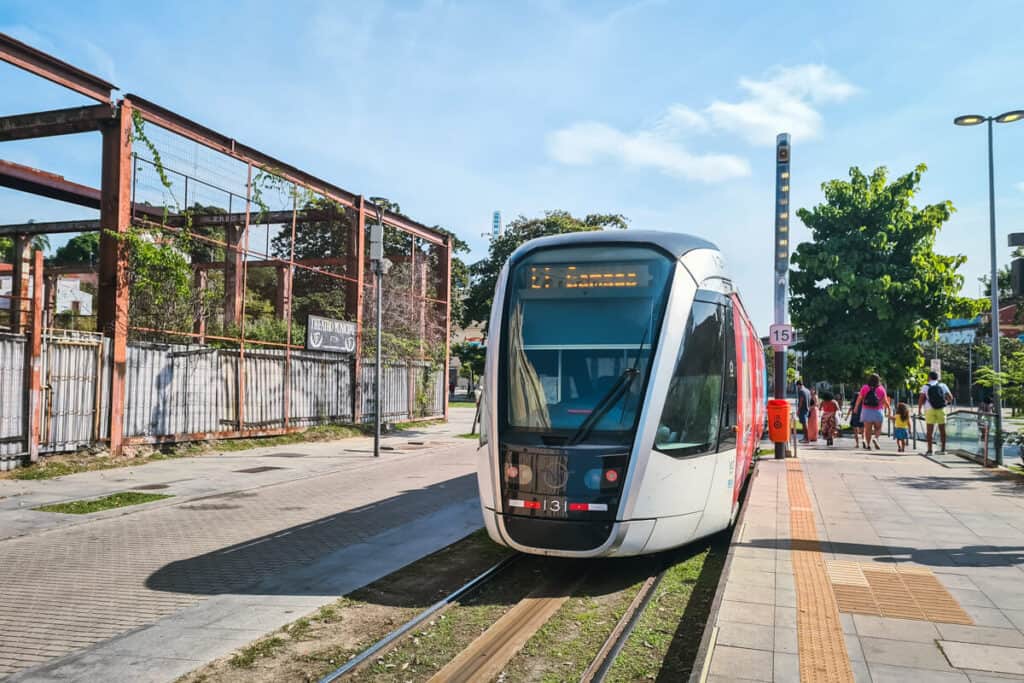
We also have a tram system which is called VLT (“veículo leve sob trilhos”, which translates into light rail vehicle).
The VLT was just recently introduced to the public transport system in Rio de Janeiro and it runs only in the city center. It was built for the Rio 2016 Olympic Games and has been working ever since.
The VLT is a very useful transport option for visiting the city center because it goes through the most important spots, including areas that are pedestrian-only zones. The VLT is the only vehicle allowed in these areas.
The VLT is also extremely useful if you will be arriving by plane in Rio through the Santos Dumont airport. There is a VLT stop right at the airport and you can use it to go to the closest subway station, and then use the metro to go to your destination. This will be the cheapest transport option from the airport, by far!
Read also: Best airport for flying into Rio de Janeiro

Ferry
We also have a ferry system in the Rio public transport, which we call “barca” in Portuguese.
The ferries connect the city center of Rio to Niterói, the largest city located across Guanabara Bay. There are also ferry stops on a few small islands along the Bay.
This transport mode is not much used by tourists because this is simply not a popular touristic route. However, if you want to visit Niterói, it’s good to know this is one of the options.
Vans

The government of Rio has been fighting for years to forbid this type of transport in Rio, but they haven’t yet been fully successful.
Within some neighborhoods and especially in the favelas, you will still see a lot of public transport being executed by vans. They go up the hills on routes where the buses are not able to pass.
In most cases, the vans are considered informal transport modes (non-official) but there are actually a few places where they are part of the official public transport system in Rio. For example, the vans you use to access The Maze Viewpoint are part of the official public transport.
How to buy a ticket for public transport in Rio
The best thing about public transport in Rio de Janeiro is that all the transport modes listed above work with a unified ticket system which is a digital card called Bilhete Único or RioCard.
If you buy a Bilhete Único, you can just top it up at any of the machines and use the credit to pay for your ticket when going into your selected transport. I’ll explain more about it in the next section.
If you don’t want to buy a card, you can also just pay for the tickets separately, on the go.
You can buy the bus ticket with cash when entering the buses and vans. For the BRT, ferry, and subway, you will need to pay for the individual ticket before you get in through the automated gates for the first time.
The VLT is the only transport option in which you don’t have a gate to go through. Security goes around randomly to check whether people paid the ticket, much like we have in Europe.
Just recently, it was implemented that you can pay for your VLT ticket using a contactless card, allowing you to buy a separate individual ticket.
Pro tip: Getting a Bilhete Único as a foreigner is not easy so if you will be using public transport in Rio just during a few days’ trip, the easiest thing to do is just buy separate tickets when you need them.
Bilhete Único – how does it work

As I’ve mentioned before, Bilhete Único is the name of the card used for the public transport system in Brazil.
There are two different kinds available – Bilhete Único Carioca and Bilhete Único Intermunicipal. The first one is valid for transport within the city of Rio de Janeiro and the second is for transport across different municipalities.
The Bilhete Único is not useful for tourists because in order to buy one, you need to have a CPF which is the Brazilian identification number. However, if you will be staying in Rio for a long time, you might want to consider this option because it will give you the right for a few discounts and bus connections.
Public transport in Rio de Janeiro – Routes and schedules
The best way to guide yourself is to use an app like Google Maps. Rio is a large city with a lot of different transport options, so trying to figure it out for yourself will just cause more trouble.
Here are some useful resources you can check:
- Google Maps – for checking the best route for going from A to B
- Waze – a lot of people here in Rio use this app for driving instead of Google Maps (I personally don’t like it)
- Metro Rio Interactive Map – useful for planning your routes before arriving in Rio (for example, checking where your hotel is, etc)
Do you need to rent a car for your trip?

We always use DiscoverCars to rent our car. So far it has proved to be not only the cheapest option but also the most reliable one. We used DiscoverCars to rent our car for our trips through Slovenia, Montenegro, Serbia, Italy, and so many other countries, and we never had any issues. We even convinced all of our friends and family to use it. So that’s why we are also recommending it to you!

Getting around Rio by bike
Cycling is another option of transport you can use to get around Rio de Janeiro.
There are a few public bike stations that you pay for the hourly fee (just like you have in major European cities as well). The most popular ones in Rio are the orange bikes by Itaú (one of the main Brazilian banks).
To use this bike, you will need to download the app, create an account, scan the QR code, and then pay for the time you spend with it. You don’t have to be a client of the bank to use the bikes, but you will have to use their app which I believe is available only in Portuguese. Check their page here.
Another option is to rent a bike. There are several bike rental companies in Rio and a lot of the hotels offer bike rental services for their guests.
If you will be staying in Copacabana, Ipanema, or Leblon, a bike can come in handy to go around the coast and through these neighborhoods. There is a dedicated bike lane by the beach which is very safe and nice to cycle.
However, I do not recommend using a bike if you will be staying much further away. We do not have many dedicated bike routes within the inner streets of the neighborhoods and it can get pretty confusing if you aren’t used to it.
Pro tip: Every Sunday and holiday, the first car lane by the beach is closed off for vehicles and becomes a cycling/pedestrian lane. This is the best day to rent a bike!
Read also: Where to stay in Rio?

Getting around Rio on foot
Last but not least, there is always the option of exploring on foot!
Rio is a very large city so you won’t be able to cross the city on foot, but you can easily explore an entire neighborhood walking if you want.
In fact, this is actually a great way of getting to know the local streets.
I highly recommend going around on foot if you will be staying in neighborhoods like Leblon, Ipanema, and Copacabana.
Keep reading for a few of my safety tips.
SafetyWing Travel Insurance

We know that insurance is one of those things that we think we don’t need… until we actually do! Dealing with hospital visits and health issues is stressful when you’re traveling, so getting a good travel insurance is the only thing that will give you peace of mind. We recommend SafetyWing, they have very flexible insurance plans covering almost every destination in the world! Take a look at their options and prices below.
Arranging transport from the airport
Rio has two main international airports: Galeão and Santos Dumont.
They are both connected to the city using Rio’s public transport system, but one of the best options for going to the airport to your accommodation is actually by taxi/uber.
If you need more information on the possible transport options, check our article about Rio’s main airports because I outlined everything there.
Safety tips when using public transport in Rio
As someone who has used all the possible transport modes in Rio and traveled extensively as a solo woman, here are a few safety tips to help you out:
- Always keep your belongings close. In fact, I highly recommend putting your backpack in front of you if you are wearing one. Pickpockets are super common.
- On the same note, pay attention to your pockets!
- Know where you are going. Using the public transport system can get confusing so make sure you always research your route beforehand, especially if you are using the subway which has a bad cellphone signal.
- If you need help, try to find younger people as they tend to speak English more often.
- Try to avoid the rush hour. Most of the public transport in Rio gets extremely crowded and you will be fighting for a place if you are going in the wrong direction at 5 pm on a workday.
- Have change with you or pay with a card – trust me, it will make things easier.
- Bus drivers are not as strict as in Europe. They often stop for people in the middle of the way and open doors in the middle of the traffic. Don’t panic, it’s totally normal.
- The safest transport options are the subway and VLT, so give preference to those if you are feeling unsure. Thankfully, they are also the easiest ones to navigate as a foreigner, so it’s a win-win.
- Especially for solo women, when getting around at night, I recommend either taking the subway or an Uber.
FAQ about using the public transport in Rio de Janeiro
Is it safe to use the public transport in Rio?
Ok, let’s start by addressing the elephant in the room…
If I have to give my honest opinion, I would say that the public transport system in Rio is not the safest but it is also not the worst. I would easily advise using the subway and the VLT, I think they are perfectly safe and up to any international standard.
However, if you will be going anywhere more remote, I normally recommend just taking an Uber instead because it is too easy to get lost. Even as a local, I don’t like getting lost in neighborhoods I am not familiar with, especially in the suburbs somewhere.
How much is the ticket for the public transport in Rio de Janeiro?
The ticket for each transport option is different.
- Subway ticket: R$ 4,65
- Bus ticket (standard fare): R$ 3,80 *
- VLT: R$ 3,80
- Ferry: R$ 21 (but varies based on the route)
* There are also a few bus routes that have higher fares because they either go out of the municipality or they are a more premium service. A good example of a premium bus line is the one that goes to the Galeão Airport.
Is there Uber in Rio?
Yes, we do have Uber and other taxi app services. I actually use them much more than regular taxis, even though those exist as well.
Read more about how Uber and taxi works in Rio.
Is the public transport in Rio running overnight?
It depends on which transport mode.
The subway closes between midnight and 5 am, as well as the VLT and the ferries.
The buses are the only transport option working 24/7 but this is not the case for every bus line. During the night, the lines are extremely reduced, getting back on between 5-7am.
If you need to go around during the middle of the night, the best option is to get an Uber/taxi.
Need help planning your trip to Rio?
We offer a lot of interesting services to help you plan your trip to Rio! As a local, I can help you with practical tips that only someone who has lived in Rio would be able to share.
If you already have an idea of an itinerary, you can get a consultation call where we answer any questions you might have and review your itinerary on the call.
Or, if you need full assistance, we also offer completely personalized itineraries! With this option, we’ll create the whole itinerary for you, including tips on restaurants and places to stay.
Organizing your trip
To help you plan your trip to Brazil, we have put together our favorite planning resources:
- Flights: Get affordable flights to Brazil on Skyscanner.com.
- Travel insurance: Make sure you are protected during your trip. We use SafetyWing whenever we are traveling abroad.
- Renting a car: We always use Discover Cars to get the best car deals.
- Accommodation: Find the best hotels and apartments on Booking.com.
- Activities: Get fun ideas of what to do and buy unique activities with Get Your Guide.
- SIM Card: Stay connected during your trip with Airalo.
- Personalized itinerary: We can create a travel plan tailored to your wishes!
- Rio de Janeiro map: All of our favorite places on one map.
Disclosure: This post may contain affiliate links. This means that we get a small commission from any purchase you make, at no additional cost to you!
