
Guide for driving in Croatia as a foreigner
Driving in Croatia is an amazing way to see the country. The country is full of incredible landscapes and going on a road trip in Croatia is a perfect bucket list item.
Since we live so close by, we take driving trips to Croatia every year so we have a lot of experience driving in the country. This article will tell you everything you need to know about driving in Croatia as a foreigner, with my personal travel tips.
Even if this will be your first road trip outside of your own country, no need to worry, driving in Croatia as a tourist is not hard and we’ll show you why in this article.
RECOMMENDED
Need to rent a car in Croatia?
We always use Discover Cars for hiring our cars abroad, whether in Croatia or anywhere else. They are the best price aggregator platform out there and allow you to find the best deals, including local and international providers!
General rules about driving in Croatia
For anyone thinking about driving in Croatia, the first step is to get familiar with the main regulations.
Here are the general rules to keep in mind for your trip:
- In Croatia, you will be driving on the right side of the road.
- Cars that are entering the roundabout have the right of way. Also, public transportation like buses and trams have the right of way on the road as well.
- Everyone in a vehicle needs a seatbelt on.
- Children aged 2 to 5 need to have a child seat suitable for their age and the car. Children older than 5 must have a seatbelt on and if necessary you can use a booster seat for them to be comfortable.
- Children cannot sit in the front until they are 12 years old.
- For drivers younger than 25, blood alcohol levels must be zero, while other drivers have an allowance of 0,5% BAC.
- Phones are not allowed and can be used only in hands-free mode.
- Winter tires are required from November until March unless you have the all-season tires which are also allowed but not recommended in very snowy conditions. Often you would need snow chains, especially on the roads in Gorski Kotar. If you will be renting a car for your trip to Croatia, make sure you check this with the rental company.
- From the end of October until the end of March, all cars must have headlights on at all times, even during daytime.
Speed limits for driving in Croatia
Knowing the speed limit before you hop behind the wheel is very important to make sure you avoid any issues. I would even say that it is the number one thing to do before driving in Croatia for the first time as a tourist so you won’t have to deal with a surprise speeding ticket like I did (more on that later).
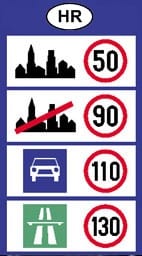
In built-up areas, the speed limit is 50 km/h which is 31 mph. Outside built-up areas, you can drive up to 80 km/h or 50 mph. However, motorways are more flexible and you can drive 130 km/h which is 81 mph.
My experience with speed limits in Croatia
The one thing you need to know about doing a road trip in Croatia is that you will be driving on small local roads if you want to visit a mix of cities and natural attractions like most people do.
During one of the first road trips I did in Croatia, I got a speeding ticket on the very last day when we were heading to the airport. The police check was set up in a very tricky spot on purpose: on a curve and during a small section of road that had limited driving limits.
I was fined on the spot and we had to put together all our Kunas to pay for the fine (we were literally out of them since it was our last few minutes in the country). Nowadays, things would be a bit easier since Croatia uses Euros – but the fines are probably more expensive as well!
I am sharing this story as an alert so you can be aware, especially when driving on local roads.
Police checks are often set up in this same exact way – disguised, and in tricky places. As a foreigner driving in Croatia for the first time, it can be easy to mistake the speed limit, especially if you are following what other cars are doing.
Locals tend to speed a lot but they know where the checks are. You will be better off respecting the speed limits than trying to follow the locals.


The eSim we recommend!
Don’t have time to read the entire guide? No problem, this is the international eSIM card we always recommend here at Mauka. It’s the one we always use when we travel and the only one that’s never let us down.
Road conditions in Croatia
Driving in Croatia is stress-free because the main roads are in good condition and maintained well. When you are on a highway, you will find many gas stations where you can stop for gas, coffee, lunch, or bathroom breaks.
Roads are considered safe, but since Croatia is a country with different landscapes, it is good to stay in touch with weather conditions all the time. On the HAK website, you can find real-time information about road closures, weather conditions, traffic jams, and more.
Smaller roads in Croatia are still good to drive, even though they are obviously less maintained than highways.
However, when traveling during the summer, we often find that trips through small roads take quite long because of construction work, so make sure you factor that in.
Information about highways & tolls in Croatia
Motorways in Croatia are toll-controlled highways that typically connect major cities. Driving on the motorways is the fastest way of traveling between places because they have the highest speed limit and fewer traffic disturbances.
When driving in Croatia, you will also find Expressways which are toll-free roads that serve as a connection between cities and highways.
Tolls on Croatian motorways operate on a closed system. This means that you take a ticket at a toll booth when entering, and then pay it when exiting the highway. Toll prices depend on the vehicle you are driving and how many kilometers/miles you have done on the highway.
Tolls can be paid in cash or you can use credit cards. The second option is to set up an ENC device and go to the toll marked ENC, which means Electronic Toll Collect System, where you can pay automatically as you pass through. When renting a car for your Croatia trip, make sure you check if the vehicle has an ENC.
Some Croatian bridges and tunnels have a toll as well. These prices are from 2025 and can be changed at any time:
- Učka Tunnel – 4,50 €
- Krk Bridge – This toll was abolished in 2020
PS: the fees for tunnels and bridges may not be applied all year long
SafetyWing Travel Insurance

We know that insurance is one of those things that we think we don’t need… until we actually do! Dealing with hospital visits and health issues is stressful when you’re traveling, so getting a good travel insurance is the only thing that will give you peace of mind. We recommend SafetyWing, they have very flexible insurance plans covering almost every destination in the world! Take a look at their options and prices below.
Driving in Croatia: Important information about ferries
Croatia has over 1000 islands, so it is very possible that your road trip itinerary will include a visit to one or more of them. In fact, some of our favorite Croatian destinations are islands such as Hvar and Korčula.
With the exception of Krk and Pag islands which are connected to the mainland by bridges, all other islands are connected by ferries that accept passengers and vehicles. When planning a road trip for driving through Croatia, make sure you consider the schedule and fare of the ferries in your plan.
Since Croatia is a tourist country, it is no surprise that some lines are operating only during the tourist season, while others are operating year-round. If you will be traveling during the summer, I highly recommend buying your ferry tickets online upfront to make sure you secure a spot on your desired time.
Jadrolinija is a national ferry operator, but there are also various private companies that you can use as well. On their website, you can check the schedule and book your tickets in advance.
Scheduling and pricing also depend on the season, with the prices being the highest between July 1st and August 31st. Some of the main hubs to catch ferries are Split, Dubrovnik, Rijeka, Zadar, and Šibenik. From these cities, you can get to almost any island in Croatia. A couple of international ferries are sailing from these cities as well, including those to Bari and Ancona, in Italy.
How is parking in Croatia
Parking is the most difficult part of driving in Croatia – or at least the most annoying one.
Finding a parking spot in the city center of most cities can be a very stressful experience. The number of places is extremely limited and the parking lots often have strict parking hours. The easiest way to go around it is to try parking in underground garages which you will find in several locations in every city. It will be more expensive but will save you time and stress.
Most public parking places work with parking machines that are easy to use and accept cash or credit card payments. Cities like Rijeka, Zagreb, and Split have parking apps you can use to pay for parking on a daily, weekly, or monthly basis. In Zagreb, you can also pay for parking by sending an SMS.
Sometimes you can find free parking outside of the city center in residential areas, but make sure it is not reserved for residents only. Free parking is also available after certain hours closer to the city center, but always check the parking sign so that you don’t get a parking ticket.
Best road trip ideas in Croatia
Need some inspiration for your driving trip through Croatia?
Here are a few suggestions for road trip ideas:
- Explore the Istrian coast with stops in Pula, Rovinj, Kamenjak National Park and more
- Visit the Plitvice Lakes from Zagreb, and then continue your trip to the coast to Zadar
- Go island hopping from Split to Hvar, Korčula, and more
- Explore Croatia from top to bottom – Start in Zagreb and make your way through the country until you reach Dubrovnik
Do you need to rent a car for your trip?

We always use DiscoverCars to rent our car. So far it has proved to be not only the cheapest option but also the most reliable one. We used DiscoverCars to rent our car for our trips through Slovenia, Montenegro, Serbia, Italy, and so many other countries, and we never had any issues. We even convinced all of our friends and family to use it. So that’s why we are also recommending it to you!
FAQ – Popular questions about driving in Croatia as a foreigner
Is driving in Croatia easy?
Yes. Roads in Croatia, especially the highway, are in excellent condition. As long as you follow the rules and speed limits, you will have no problems driving in Croatia.
Also, keep in mind that in Croatia we drive on the right side of the road and overtake on the left, so if you are coming from a country with the opposite rule this might be a little bit difficult for you.
What is the minimum age for driving in Croatia?
You have to be 18 years old to get a driver’s license, so if you are a foreigner with a driver’s license but younger than 18 you cannot legally drive in Croatia as a tourist.
On top of that, many car rental companies will charge an additional fee if you are younger than 23 or 25 years old. This is called a “young driver fee” and is added on top of the rental price. Make sure you read the fine print when renting a car to know what you’re getting into. We always use DiscoverCars on our trips.
Can tourists drive in Croatia?
Yes, tourists can drive in Croatia as long as they have a valid driving license. EU and EEA licenses are accepted without any extra regulations.
If your driving license was not issued using Latin characters, you will also need to have an International Driving Permit (IDP). We recommend checking the specific regulations for your country before your trip.
Can you drive in Croatia with a US driver’s license?
Driving in Croatia with a US license is possible if you are 18 or older. You can drive with a US license for up to three months, the same length as the visa-free tourist visit to the country.
If you apply for Croatian residency, you can drive with a US driver’s license for up to a year, and after that, you must replace it with a Croatian driver’s license.
Can you drive in Croatia with a UK driver’s license?
Driving in Croatia is possible with a UK driver’s license for up to 12 months. After a year, you must apply for a Croatian driver’s license by doing a medical exam, filling out the paperwork, and paying the fee.
What do I need to know before driving in Croatia?
Croatians love their cars, and very often you will see amazing cars on the road going over the speed limit. As a foreigner driving in Croatia, I recommend you to always stay at the speed limit and drive carefully. Don’t follow the locals because they are familiar with the roads, you are not.
You should also know that Google Maps works really well, even in rural areas. In my experience, I have found the roads to be very well mapped so it is easy to get around.
With these main guidelines, we believe you are well-equipped for your next road trip. I truly believe that driving in Croatia is one of the best ways of exploring the country, so I really encourage you to hop on this adventure.
Will you be traveling through the Balkans?
Check some of our other driving guides:
Organizing your trip
To help you plan your trip to Croatia, we have put together our favorite planning resources:
- Flights: Get affordable flights to Croatia on Skyscanner.com.
- Travel insurance: Make sure you are protected during your trip. We use SafetyWing whenever we are traveling abroad.
- Renting a car: We always use Discover Cars to get the best car deals.
- Accommodation: Find the best hotels and apartments on Booking.com.
- Activities: Get fun ideas of what to do and buy unique activities with Get Your Guide.
- SIM Card: Stay connected during your trip with Airalo.
Disclosure: This post may contain affiliate links. This means that we get a small commission from any purchase you make, at no additional cost to you!
